
'/%3E%3C/g%3E%3Cuse%20href='%23c'%20transform='matrix(-1%200%200%201%20720%200)'/%3E%3C/svg%3E)
'/%3E%3C/svg%3E)
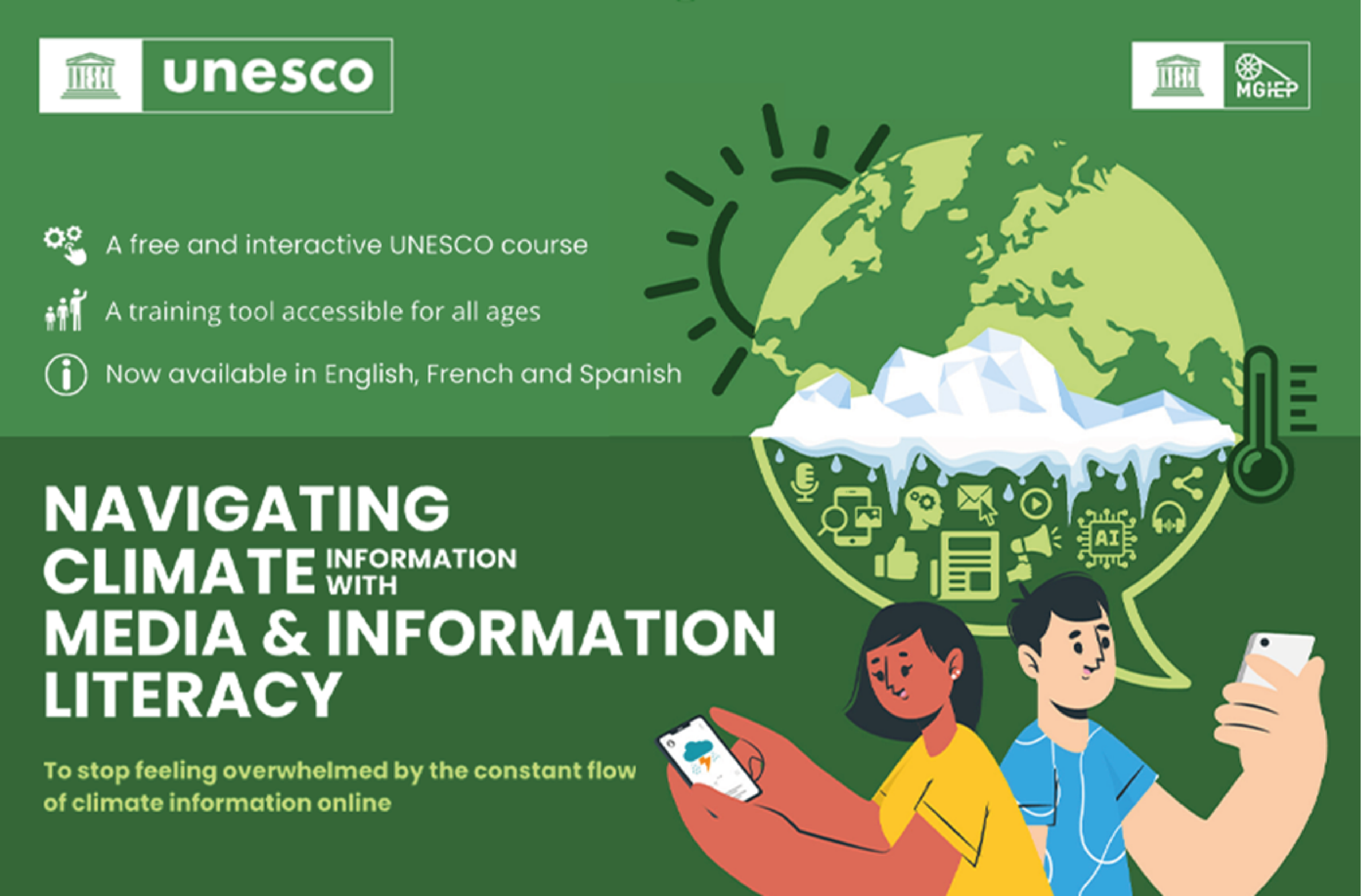
Can you tell facts from myths about the climate? UNESCO offers free climate literacy course
Knowing how to identify reliable information about the climate is an increasingly growing challenge. Mastering the fundamental concepts needed to take part in informed discussions on the subject also requires ever greater preparation.
At a time when misinformation about climate change is increasing in digital environments, the ability to understand climate information has become an essential skill for citizens, students, communication professionals and the general public.
It is precisely to address this challenge that UNESCO, in partnership with MGIEP (the UNESCO Mahatma Gandhi Institute of Education for Peace and Sustainable Development), has relaunched the course “Navigating Climate Information for Media and Information Literacy”, now available in English, French and Spanish.
The UNESCO Chair of Communication, Media and Information Literacy and Citizenship, LIACOM and the School of Communication and Media Studies (ESCS) are joining in promoting this international initiative, which aims to strengthen media literacy skills applied to climate issues.
A free course offered by UNESCO
Through interactive modules and a self-paced learning format, this training course offers practical tools for assessing sources, interpreting data and participating in climate discussions in an informed and responsible way, especially in digital environments.
Some key features of this course:
- Free;
- Interactive;
- Can be completed in 3 to 5 hours;
- Designed for audiences of all backgrounds and ages, from 12 years old upwards;
- Available online in English, French and Spanish, with access provided through different links for each language.
At the end, participants may request a certificate from UNESCO and MGIEP.
ESCS UNESCO Chair is committed to climate literacy
Strengthening knowledge for responsible and informed climate action and communication is one of the goals of the UNESCO Chair at LIACOM/ESCS, in line with the work that has been developed at the intersection of communication, media and information literacy and citizenship.
Recent initiatives by this Chair in the area of climate education include:
- Participation in the InfoClima project, promoted by ZERO – Sustainable Earth System Association, dedicated to empowering university students to understand the scientific foundations of climate change and environmental crises, as well as to identify mechanisms of manipulation and misinformation that affect public debate on climate. The project includes workshops, the creation of a public campaign, and a mural painting.
- The development and publication of the ebook “Climate Journalism: A Guide for Future Journalists”, a handbook aimed at supporting Journalism students beginning to explore climate information, developed in partnership with Oslo Metropolitan University (OsloMet), Norway. The Guide starts by defining five steps to “dive into” climate journalism and offers tips from experienced journalists in the field. Learn more about this resource here.
