


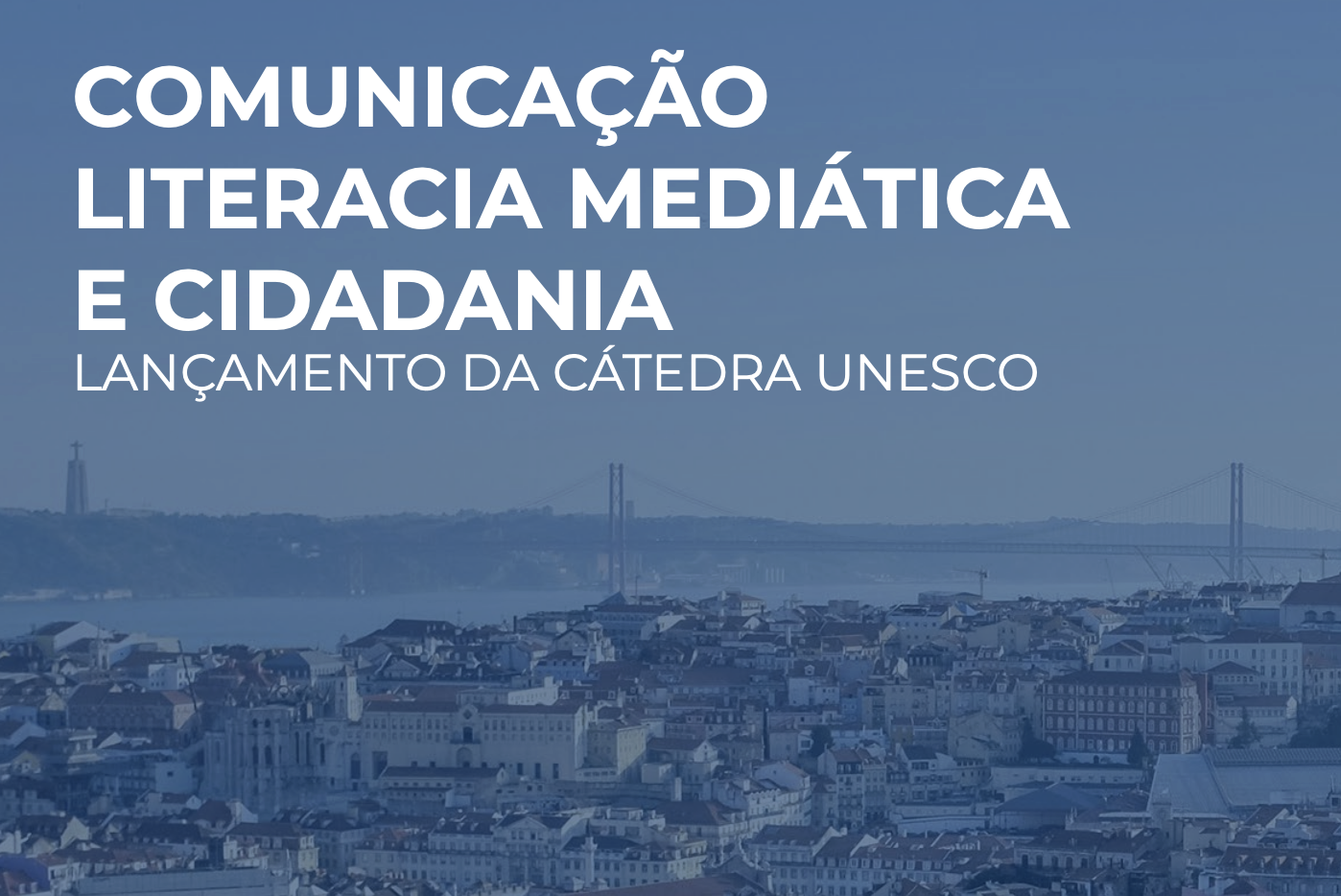
Now available UNESCO Chair ebook to commemorate “a date that marks the beginning of our story”
The ebook that recalls the official launch ceremony of the UNESCO Chair in Communication, Media and Information Literacy and Citizenship, at the School of Communication and Media Studies of the Polytechnic University of Lisbon (ESCS-IPL), is now available (in Portuguese) in the IPL repository and on the Chair’s website.
The book, entitled Communication, media literacy and citizenship: Launch of the UNESCO Chair (Comunicação, literacia mediática e cidadania: Lançamento da Cátedra UNESCO, in the original), seeks, on the one hand, to document the commitments undertaken at the official presentation of the Chair, on October 30, 2024, at the Vítor Macieira Auditorium (ESCS-IPL), and, on the other, to “record the richness of the diversity experienced” during that session, as stated in the book’s introduction.
Reflecting the very spirit of the Chair, the book reconciles the academic dimension, clarification through facts, and encouragement of critical reflection, while simultaneously embodying the “spirit of interdisciplinarity, co-creation, and commitment to the community,” thus bearing witness to the work of a vast team.
Organized into five parts, the ebook begins by offering the possibility of revisiting the discourse of Maria Augusta Babo, researcher at ICNOVA – Instituto de Comunicação da NOVA, who invites us to learn about the “conceptual foundations” of the terms that give the Chair its name (communication, media literacy, and citizenship) in order to reflect on how we experience these concepts today in our interpersonal relationships.
The second part recalls the speech of Paolo Celot, founder and director of the European Association for Viewers Interests (EAVI). Based on data about the functioning of digital platforms, the need to promote knowledge of the media ecosystem and safeguard the full experience of citizenship as a common good is discussed.
Next, the holders of the UNESCO Chair and professors at ESCS-IPL, Fernanda Bonacho (holder) and João Abreu (co-holder), share the vision that was at the genesis of the project and that guides its development. It is in this third part that we learn about the objectives, the team, the work plan, and the expected outcomes of the Chair.
Soon after, in the Gallery, photographic records of the Música na Comunidade (Music in the Community) project are shared. Based on the idea of “freedom,” this project created a performance combining video, sound, and body expression, in a partnership between the Lisbon School of Education (ESELx) and the Lisbon School of Music (ESML).
Finally, in the Afterword, Filipe Barrocas Lima, professor at ESCS-IPL and co-organizer of the book, explains the process of creating this publication, developed from a project by students Gonçalo Conceição, João Delgado, Miguel Vida-Larga, and Rafael Almeida, as part of the Graphic Communication Course Unit of the Public Relations and Corporate Communication degree at ESCS-IPL. The ebook is testimony to how design can play an “active role in the sustainability of public space,” helping to make “visible what would otherwise remain opaque,” in the words of the professor and member of the Chair’s coordination team.
Returning to the introduction: “We learn early on that stories should have a beginning, middle, and end. This ebook recalls a date that marks the beginning of our story.”
The book “Communication, Media Literacy and Citizenship: Launch of the UNESCO Chair” was coordinated by Fernanda Bonacho and Filipe Barrocas Lima, professors at ESCS-IPL and researchers at LIACOM.
