


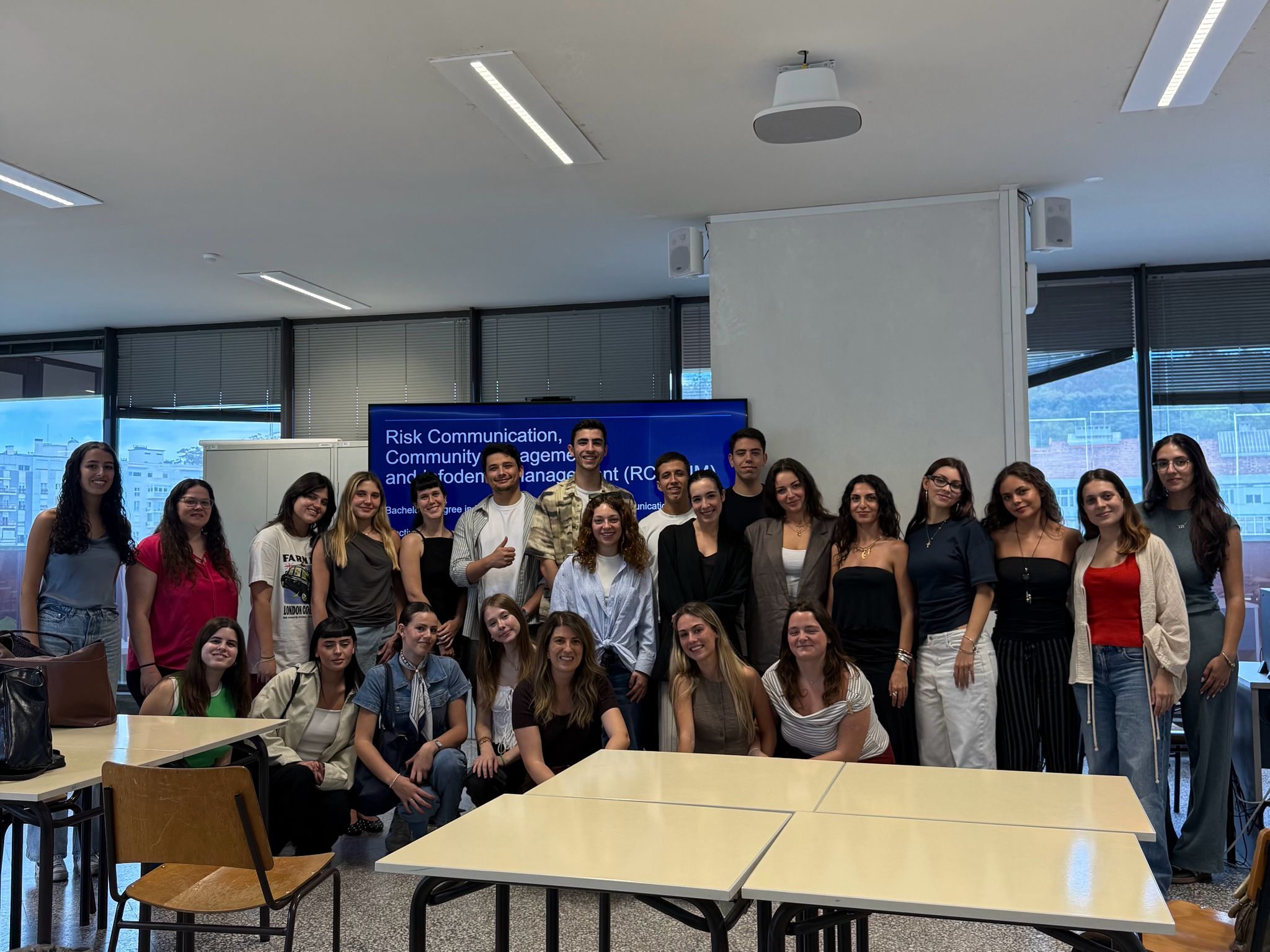
ESCS and WHO launch pioneering course in risk communication and infodemic management
During the second semester of the 2025/2026 academic year, students of Public Relations and Corporate Communication (RPCE) at the School of Communication and Media Studies (ESCS) had the opportunity to take part in the pilot edition of the elective course Risk Communication, Community Engagement and Infodemic Management (RCCE-IM), developing competencies in a field that is central to public health emergency preparedness and response.
This elective course is the result of a partnership between ESCS and the World Health Organization Regional Office for Europe (WHO/Europe), with the aim of preparing communication professionals to work in multidisciplinary teams in a context shaped by misinformation, where emergencies have become increasingly frequent.
“Preparing future communication professionals to respond effectively to disasters and emergencies is an urgent challenge for public relations education. Recent emergencies, including pandemics, the climate crisis, and humanitarian crises, have demonstrated that failures in risk communication can put people’s lives at risk,” says Professor Tatiana Nunes, the course coordinator.
Throughout the semester, students explored topics including risk communication, community engagement, social listening, audience segmentation, message development and testing, rumour management, and responding to misinformation. Teaching was based on active learning methodologies, including simulations, case studies, role-playing, problem-solving exercises, and group work.
The UNESCO Chair of Communication, Media and Information Literacy and Citizenship (LIACOM/ESCS) highlights the importance of this course as an example of the commitment to innovative education, particularly at a time when there is an urgent need to train responsible and critical communication professionals who can contribute to a rigorous and human-centred information ecosystem. In a context characterised by the growing spread of misinformation and the increasing complexity of emergencies, preparing professionals who can communicate with accuracy, responsibility, and ethical awareness plays a decisive role in fostering public trust and informed citizenship.
The pilot experience
The RCCE-IM course was taught by Tatiana Nunes in collaboration with Nancy Claxton, a specialist from WHO/Europe. It also featured contributions from representatives of WHO and Portugal’s Directorate-General of Health (DGS), including Gisela Leiras, coordinator of the Working Group on Behavioural Sciences, Health Communication and Community Engagement (GT-3C). Their participation provided students with valuable insights into real-world emergency response and public communication contexts.
As their final project, students developed emergency response plans addressing risk scenarios relevant to the Portuguese context, including dengue outbreaks, food contamination incidents, heatwaves and drought, rural wildfires, and conflict situations.
The pilot edition also stood out for its use of WHO tools, including the Capability Mapping Tool (CapMap), a self-assessment instrument for RCCE-IM capacities, and the Pocket Plan Creator, which served as the framework for structuring the intervention plans developed by the students.
Through this initiative, ESCS reinforces its commitment to educating communication professionals who are equipped to respond to complex emergencies characterised by uncertainty, crisis, and misinformation.
Looking ahead
Following the implementation of this pilot course, WHO and ESCS are jointly evaluating the programme and preparing a model for replication, enabling other higher education institutions to incorporate RCCE-IM into their curricula.
Building on this successful collaboration, the two institutions are currently developing additional joint initiatives to be launched over the coming months.
