


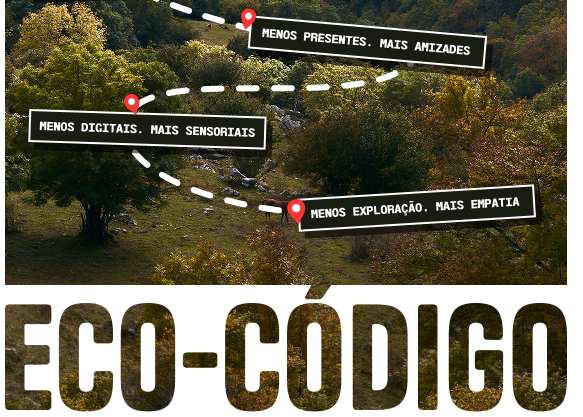
New ESCS Eco-Code: A conscious journey from commitment to action
The Eco-Code poster selected by the School of Communication and Media Studies (ESCS) for the 2025/2026 academic year challenges the community to turn intentions into concrete actions and invites everyone to choose one action they are committed to contributing.
The Eco-Code is one of the seven steps of the Eco-Schools Programme, of which ESCS is a member. It sets out a series of principles and actions aimed at improving environmental performance and promoting sustainability.
Each year at ESCS, a graphic design created by students is selected to represent the commitment of the entire academic community to building a more responsible future.
This year’s winning proposal was created by Irina Carvalho Dores and Simão Antunes Duarte, second-year students of Audiovisual and Multimedia. The project was developed as part of the Multimedia Design course under the supervision of Professor Ricardo Rodrigues.
The poster features a sequence of messages presenting individual and collective challenges that encourage the adoption of more sustainable everyday behaviours.
The journey begins and ends with the same message: “Less exploitation. More empathy.” Other challenges include: “Less consumption. More awareness.”, “Less waste. More resources.”, and “Less digital. More sensory.”
The messages were developed by the ESCS Eco-Schools Council, which then challenged students to create an original visual communication concept to bring them to life.
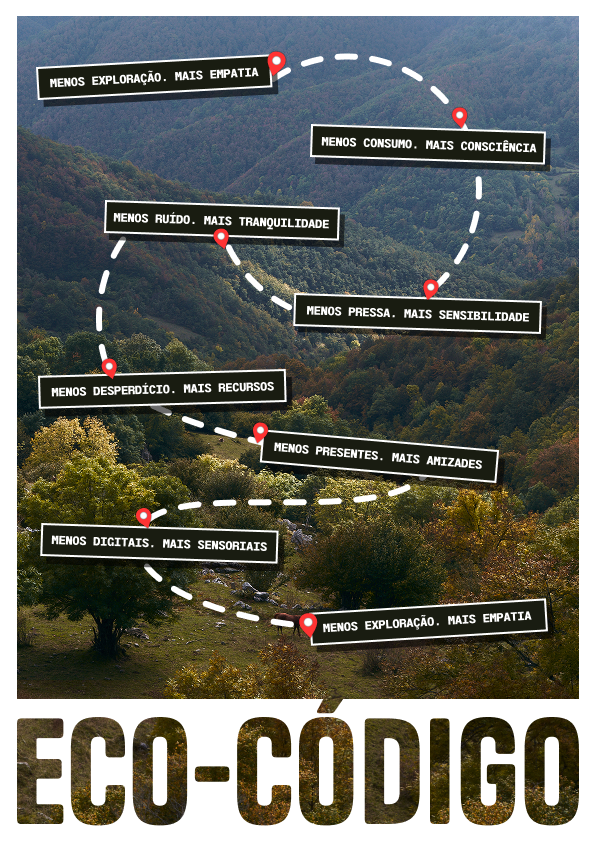
The main idea is to “guide the viewer along a ‘conscious journey,'” as the authors explain in their proposal. “Along this journey, viewers encounter a natural landscape of Mediterranean vegetation, which is widely found in Portugal and across the Iberian Peninsula,” they add.
ESCS has been an Eco–School since 2019 and it is integrades in an EcoCampus, which was recognised as such in 2024.
The ESCS Eco-Schools Committee is supported by the UNESCO Chair of Communication, Media and Information Literacy and Citizenship (LIACOM/ESCS), which is committed to the Sustainable Development Goals (SDGs) and to promoting initiatives and projects that contribute to more sustainable societies.
Eco-Schools is an international programme of the Foundation for Environmental Education (FEE). In Portugal, it has been coordinated by the ABAAE – Blue Flag Association for Environment and Education since 1996.
