


Reading with Eyes and Ears: EntreLinhas brings together cinema, reading, and memory
The 9th session of the EntreLinhas Reading Club, held on April 23rd, World Book Day, was dedicated to the documentary A Leitora (The Reader), a film that invites us to reflect on reading as a relational practice that is developed over the course of a lifetime.
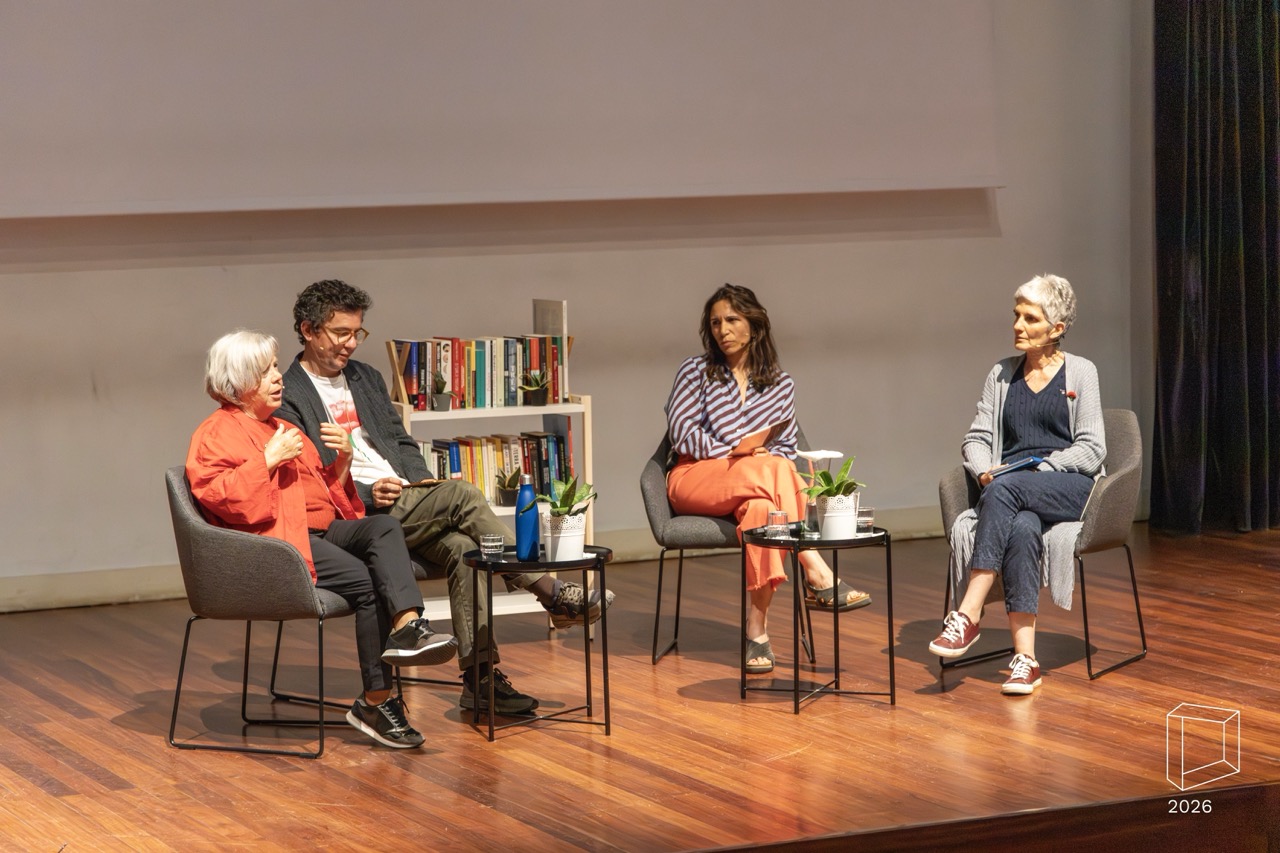
The session, themed “Reading with Eyes and Ears,” began with a screening of the film at the Vítor Macieira Auditorium of the School of Communication and Media Studies (ESCS-IPL), followed by a discussion featuring Maria da Encarnação Silva, the documentary’s protagonist, and three members of the project team and ESCS lecturers – Joana Souza, Joana Pontes and Ricardo Pereira Rodrigues.
When asked to think of an image that represented their relationship with reading, the guests shared a wide range of perspectives. Maria da Encarnação Silva described reading as a “plural entity,” proposing three images: reading associated with affection, illustrated by a child sitting on an adult’s lap while both look at a book; reading as access to knowledge and symbolic power, represented by a large key opening the door to a castle; and literary reading, symbolised by the image of a bridge capable of connecting times, peoples and experiences, opening the way to empathy.
Ricardo Pereira Rodrigues, a professor of Audiovisual and Multimedia, evoked specific people who shaped his journey as a reader – teachers, librarians, reading mediators and his own children – reinforcing the idea that books serve as markers of human connection. Joana Pontes, filmmaker and professor of Storytelling and Scriptwriting for Journalism, highlighted silence, space and presence as essential conditions for reading, sharing family memories and the sense of “wonder” associated with the time she discovered she already knew how to read.
Throughout the discussion, Joana Souza, project coordinator for the documentary, summarised an idea that ran through the entire session: the images associated with stories are often relational. This dimension was also central to the conversation about the role of audiovisual media in promoting reading. Joana Pontes stressed that, in documentaries for example, it is essential to “humanise the subjects” and to use people’s life stories as a starting point for exploring broader historical or social themes. For Ricardo Pereira Rodrigues, reading is not simply about opening a book; it involves concentration, availability and biographical construction.
“One thing is to decipher a text; another is to decipher and understand it; another still is to decipher it, understand it and be able to express a critical opinion about it.” – Maria da Encarnação Silva
The session concluded with an open discussion with the approximately 35 people in the audience, most of whom were ESCS students. One of the students shared that the film helped him realize that reading is a privilege that is often taken for granted. Two other students took the opportunity to ask Maria da Encarnação Silva, a retired teacher, how it is possible to spark interest in books in a world marked by constant acceleration. The answers, without offering fixed formulas, suggested relatively simple ideas: with children, all it takes is a book, a body and a voice; with teenagers and adult readers, sometimes sharing stories is enough to awaken curiosity.
The 9th session of EntreLinhas thus reaffirmed reading not merely as a skill, but as a living, emotional, and deeply human experience.


The EntreLinhas Book Club is organized by the UNESCO Chair of Communication, Media and Information Literacy, and Citizenship (LIACOM/ESCS-IPL).
The documentary A Leitora (The Reader) emerged from the DOC-EDU project, developed by researchers from ESCS-IPL and LIACOM, in partnership with the Lisbon School of Education (ESELx), with funding from IPL through the IDI&CA programme. Partners in the project also include Escola Artística António Arroio and the UNESCO Chair of Communication, Media and Information Literacy and Citizenship.
