
'/%3E%3C/g%3E%3Cuse%20href='%23c'%20transform='matrix(-1%200%200%201%20720%200)'/%3E%3C/svg%3E)
'/%3E%3C/svg%3E)
“Words that happen to us”: Portuguese Language in a EntreLinhas intercultural meeting
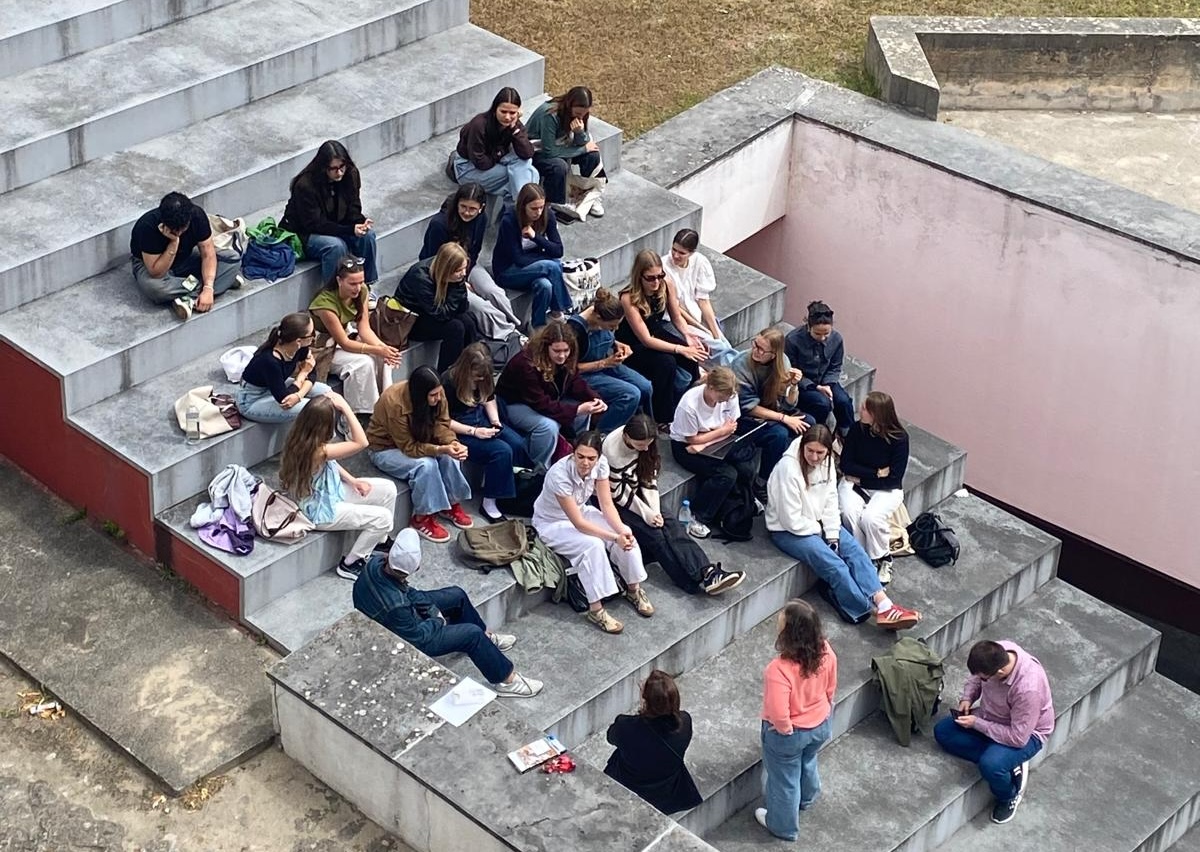
On May 5th, 2026, the EntreLinhas Reading Club held its 10th session, an intercultural Open Class dedicated to the World Portuguese Language Day. The gathering took place on Escadas do Infinito at the School of Communication and Media Studies (ESCS-IPL).
The session, organised in partnership between the UNESCO Chair of Communication, Media and Information Literacy and Citizenship (LIACOM/ESCS-IPL) and the course Communication, Information and Social Media Literacy, brought together around 25 students from 9 European countries in a gathering centred on the Portuguese language as a space for connection, diversity, and the construction of meaning.
Under the theme “Words that happen to us: Expressing the world in Portuguese,” participants were invited to bring a Portuguese word that held special meaning for them.
The words shared, and the reasons behind the choices, were highly diverse: “mother” (mãe) – connected to Mother’s Day and recalling one student’s mother’s relationship with books; “woman” (mulher) – evoking human rights, gender equality and the experience of participating in a feminist demonstration; “lost” (perdido) – inspired by the experience of getting lost in Lisbon; “little bird” (pardalinho) – a term of endearment used by a participant’s father; “dawn” (amanhecer) – reflecting the Erasmus experience as the beginning of something new; “care” (cuidado) – in the sense of interpersonal and human care; among many others.
Each participant was also challenged to bring a reference to a book from their own country that, in some way, connected with their chosen word. Among the works shared were King Kong Theory, by French writer Virginie Despentes, associated with the word “woman”; Abigél, by Hungarian author Magda Szabó, linked to the idea of care; The Unbearable Lightness of Being, by Milan Kundera, suggested by a Czech student who chose the word “existence”; The Musicians of Bremen, by the Brothers Grimm, mentioned by a German student and associated with the word “friendship”; and Blindness, by Portuguese Nobel Prize-winning author José Saramago, suggested by one of the lecturers and facilitators of the session, who chose the word “listening.”
Throughout the session, it became clear how words help reflect the experiences that shape and transform us, reinforcing their role in bringing people closer together through what they have in common — “communicating”.
The session fostered an atmosphere of listening and exchange, in which the Portuguese language served as a starting point for exploring the connections between identity, culture and literacy.
