


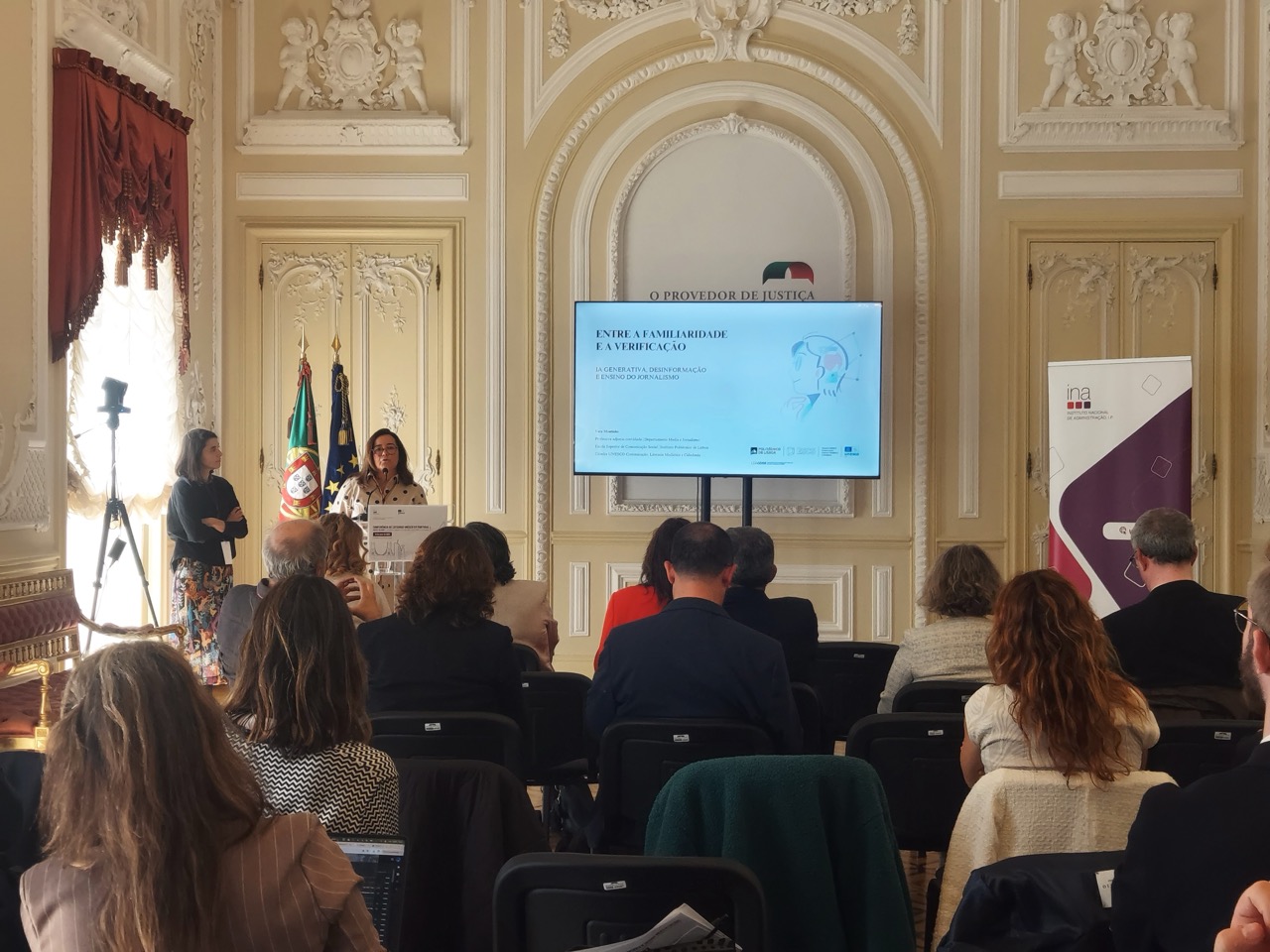
ESCS UNESCO Chair discusses the impact of AI on journalism education at the Portuguese UNESCO Chairs Conference
The UNESCO Chair of Communication, Media and Information Literacy and Citizenship (LIACOM/ESCS-IPL) took part in the 2026 Conference of Portuguese UNESCO Chairs, dedicated to the theme “80 years of UNESCO – Education, Science and Culture for Peace and Cooperation,” held at Provedoria de Justiça, on May 15th in Lisbon.
Featuring presentations from 18 national UNESCO Chairs, the conference addressed key issues for the future of democratic societies, including global citizenship and education; the environment, heritage and the preservation of cultural diversity; open science, inclusion and participation; as well as the challenges posed by disinformation and generative artificial intelligence.
The ESCS UNESCO Chair was represented by Fernanda Bonacho, Chair holder, ESCS lecturer and LIACOM researcher, and Vera Moutinho, journalist, ESCS lecturer, LIACOM researcher and member of the Chair’s team. Together, they presented the paper “Disinformation and Generative Artificial Intelligence: Challenges for Journalism and Education.”
Focusing on the relationship between generative artificial intelligence (AI), disinformation and journalistic verification, the presentation offered a pedagogical reflection on an experience of integrating generative AI into journalism education. Vera Moutinho explained that, within the framework of developing a pilot module for the course Multiplatform Journalism (ESCS), created as part of the European project Artificial Intelligence in Higher Education Teaching and Learning (AI-HED), it was possible to observe a tension between students’ familiarity with tools such as ChatGPT and the lack of consolidated critical AI literacy. The lecturer stressed that the results suggest AI should be integrated into journalism education through human-in-the-loop pedagogies, guided by journalistic values, human oversight and editorial responsibility.
The final exchange of ideias and discussion was highly enriching and, during the debate among participants, there was a clear sense that there is both room and a willingness to explore potential avenues for collaboration between the different departments of the Chairs.
The 2026 Conference of Portuguese UNESCO Chairs marked UNESCO’s 80th anniversary and was organised by the Portuguese National Commission for UNESCO (CNU), in partnership with the UNESCO Chair in Education for Development in Public Administration at INA (National Institute of Administration).
